Why Won't My Homemade Fudge Harden? Common Fixes & Tips
Discover why homemade fudge stays soft, learn the science behind setting, and get practical fixes, tips, and a reliable recipe for perfect fudge every time.
Read MoreWhen dealing with fudge hardening, the unwanted firming that turns a silky fudge into a brittle slab. Also known as fudge firming, it often stems from a mix of temperature mistakes, sugar crystallization, and poor storage. Closely linked is fudge texture, the smooth, melt‑in‑your‑mouth quality you expect from a good fudge, while sugar crystallization, the process where dissolved sugar forms hard crystals and storage conditions, the environment where you keep the finished fudge act as the main culprits. Understanding how these pieces fit together lets you stop the hardening before it starts.
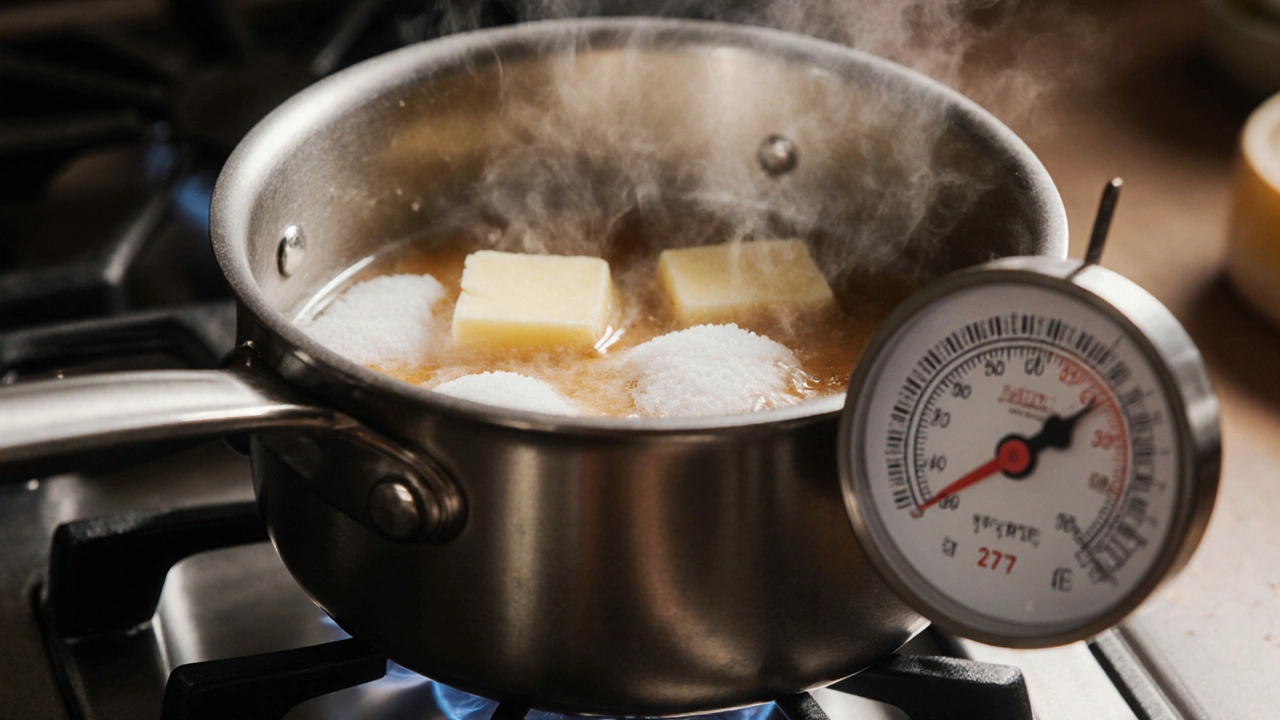
First up, temperature control. Fudge recipes usually call for heating a sugar‑milk‑butter mixture to the "soft‑ball" stage, around 235‑240°F (112‑115°C). Drop below that range and you risk a grainy, under‑cooked batch; go too high and the mixture becomes a hard candy that will never soften. Using an accurate candy thermometer is a simple, cheap way to stay in the sweet spot. Once you hit the right temperature, let the fudge cool undisturbed until it reaches about 110°F (43°C) before you start beating. That pause lets the sugar molecules align properly, setting the stage for a creamy texture rather than a rock‑hard one.
Second, the sugar crystallization timing matters. Stirring too early—while the mixture is still too hot—introduces tiny crystals that act as nuclei, causing the whole batch to solidify quickly. The rule of thumb is to wait until the surface forms a thin skin, then give it a gentle, rhythmic stir for a few minutes. This encourages the formation of many small crystals, which melt in your mouth instead of snapping. Adding a splash of corn syrup, glucose, or even a bit of butter can interfere with crystal growth, giving you a softer final product.
Third, the type of sugar you use influences how easily fudge hardens. Granulated white sugar works fine, but switching to superfine caster sugar reduces the chance of large crystals forming. Some bakers also sprinkle a pinch of salt or a dash of vanilla extract; they don’t affect hardness directly but improve flavor, making the fudge more enjoyable even if it does firm up a bit.
Fourth, storage conditions are the final piece of the puzzle. Once your fudge has set, wrap it tightly in plastic wrap or store it in an airtight container. Exposure to air dries out the surface, leading to a crust that feels hard. Keep the fudge in a cool, but not cold, spot—around 65‑70°F (18‑21°C) is ideal. Refrigeration can make it too firm, while a warm kitchen can melt the glossy finish. If you need to freeze fudge for longer storage, slice it first, wrap each piece, and let it thaw slowly at room temperature to preserve the silky texture.
Finally, let’s talk about practical troubleshooting. If you end up with a batch that’s too hard, you can rescue it by gently reheating a slice in a microwave for a few seconds, then stirring in a splash of milk or cream. The added liquid breaks up the stubborn crystals and restores some softness. For future batches, experiment with a short “crash cooling” step: after reaching soft‑ball temperature, pour the fudge onto a cool marble surface, spread it thinly, and let it set quickly. This method reduces the time the mixture spends at the critical temperature range, lowering the chance of unwanted crystallization.
All these tips—from precise heating and delayed stirring to smart storage—form a roadmap that keeps your fudge from turning into a brick. Below you’ll find a curated collection of articles that dive deeper into each of these areas, share real‑world examples, and offer step‑by‑step guides. Whether you’re a beginner who’s just mastering the soft‑ball stage or a seasoned candy maker looking to fine‑tune your technique, the posts ahead will give you actionable insights to master the art of soft, luscious fudge.
Discover why homemade fudge stays soft, learn the science behind setting, and get practical fixes, tips, and a reliable recipe for perfect fudge every time.
Read More