If you’ve ever made fudge and ended up with a sticky, gooey mess instead of a firm, sliceable treat, you’re not alone. Condensed milk fudge is supposed to be simple-just heat, stir, pour, and wait. But when it doesn’t set, frustration kicks in. The truth? It’s rarely about the condensed milk itself. It’s about what you do with it.
Condensed milk isn’t the problem
Many people blame the condensed milk when their fudge doesn’t set. But sweetened condensed milk is already thick, sugary, and cooked down. It’s designed to help fudge firm up. If your fudge stays soft, the issue isn’t the milk-it’s how you handled the sugar, heat, or cooling process.
Condensed milk contains about 45% sugar and very little water. That’s why it works so well in fudge. But sugar doesn’t just magically turn into a solid when mixed with milk. It needs to crystallize properly, and that only happens under the right conditions.
The real culprit: temperature control
Fudge sets because sugar reaches the soft-ball stage-around 234°F to 240°F (112°C to 116°C). At this point, the sugar syrup is concentrated enough to form soft, pliable crystals when cooled. If you don’t get the mixture hot enough, the sugar stays too watery. If you go too far, you get hard, grainy fudge.
Most home cooks skip using a candy thermometer. They guess. They wait for bubbles. They stir until it looks "thick enough." That’s not enough. Without a thermometer, you’re flying blind.
Here’s what actually happens when you don’t hit the right temperature:
- Below 234°F: Sugar syrup is too watery → fudge stays runny
- Between 234°F-240°F: Perfect for fudge → smooth, firm texture
- Above 240°F: Sugar becomes too concentrated → fudge turns grainy or hard
Use a candy thermometer. Don’t skip it. Even if you’ve made fudge 10 times before, this is the single most reliable fix.
Stirring too soon ruins everything
Another big mistake? Stirring the mixture while it’s still hot.
Once you take the fudge off the heat, you need to let it cool to about 110°F (43°C) before stirring. That’s when you add vanilla, chocolate, nuts, or anything else. If you stir it while it’s still hot, you trigger premature crystallization. Sugar crystals form too early and get smashed into a grainy mess instead of staying smooth.
Think of it like making whipped cream. If you start whipping it while it’s warm, it won’t hold. Same idea. Let it rest.
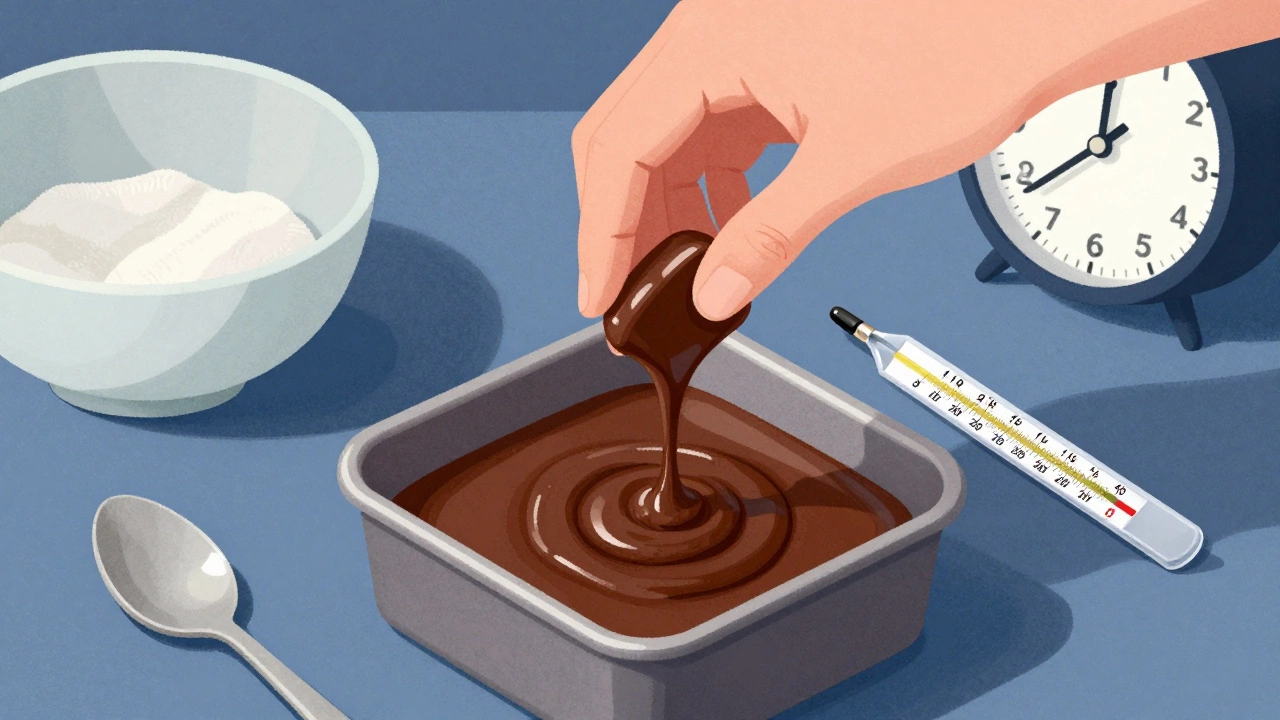
Here’s the right sequence:
- Heat sugar, butter, and condensed milk to 234°F-240°F
- Remove from heat. Do not stir.
- Let cool undisturbed for 15-20 minutes, until it’s lukewarm
- Add flavorings and mix gently
- Pour into pan and let set at room temperature for 2-3 hours
Cooling too fast? That’s also a problem
Some people think putting fudge in the fridge will speed things up. It doesn’t. It hurts.
Chilling fudge too quickly causes uneven crystallization. The outside hardens while the inside stays soft. You might even see condensation forming on the surface, which adds moisture and makes it sticky.
Let fudge set at room temperature. Cover it lightly with parchment paper or a clean towel to keep dust out. Wait. Patience is part of the recipe.
Humidity is secretly sabotaging your fudge
Did you make this on a rainy day? Or in a steamy kitchen? That matters.
Sugar is hygroscopic-it pulls moisture from the air. On humid days (over 60% humidity), your fudge absorbs extra water from the air, which keeps it soft. This is why fudge made in Florida in July might never set, but the same recipe works perfectly in Colorado in December.
If you’re in a humid climate, try this:
- Make fudge on dry days when possible
- Run a dehumidifier in the kitchen
- Store finished fudge in an airtight container with a silica gel packet

What if you already messed it up?
Don’t throw it out. You can still fix soft fudge.
Scrape it back into a saucepan. Add 1/4 cup of heavy cream or whole milk. Heat it back up to 234°F-240°F. Stir gently until smooth. Remove from heat. Let cool again, then stir in flavorings. Pour into a fresh pan. This resets the sugar structure.
It’s not ideal, but it works. And you’ll learn exactly where you went wrong next time.
Recipe checklist: What to check before you start
Before you even turn on the stove, run through this quick list:
- ✅ Are you using full-fat sweetened condensed milk? (Not evaporated milk, not coconut milk)
- ✅ Do you have a reliable candy thermometer?
- ✅ Are you heating to exactly 234°F-240°F?
- ✅ Are you letting it cool to 110°F before stirring?
- ✅ Are you leaving it at room temperature for at least 2 hours?
- ✅ Is the kitchen dry? (Avoid humid days if possible)
If you checked all these, and your fudge still won’t set, double-check your ingredients. Some brands of condensed milk have added stabilizers or water. Stick to classic brands like Eagle Brand or Nestlé.
Why this happens more often than you think
Fudge recipes are deceptively simple. That’s why they’re popular. But simplicity hides complexity. Sugar chemistry is unforgiving. A 5-degree difference in temperature, a 3-minute delay in cooling, or a single humid hour can change the outcome.
Professional chocolatiers use thermometers, controlled environments, and precise timing. You don’t need to be a pro-but you do need to treat sugar like a science, not a guess.
Once you nail the temperature and the cooling steps, your fudge will set perfectly every time. No more sticky bowls. No more wasted ingredients. Just rich, smooth, melt-in-your-mouth fudge.